At a glance
- The plan: Adults need muscle-strengthening activity on at least 2 days each week.
- What’s new: This home plan gives every movement a substitute and still covers all major muscle groups.
- This week: Learn the basic movements and repeat them on 2 days.
Could two short sessions a week at home be enough to start getting stronger? It’s a realistic place to begin. The CDC says adults need muscle-strengthening activity on 2 or more days a week that works the legs, hips, back, abdomen, chest, shoulders, and arms. This guide to strength training for beginners female at home is built around that baseline. You don’t need equipment, and you don’t have to get every rep perfect.
What is resistance training for beginners? It’s muscle-strengthening work done on purpose, where your muscles push or pull against resistance. That resistance can be your body weight, a wall, or a sturdy chair. What is weight training for beginners? People often use the term loosely for the same kind of work, even when no dumbbells are involved.
The rule here is repetition over perfection. Come back to the same few movements, notice what feels steady, and change only one thing at a time.
What this beginner home plan covers
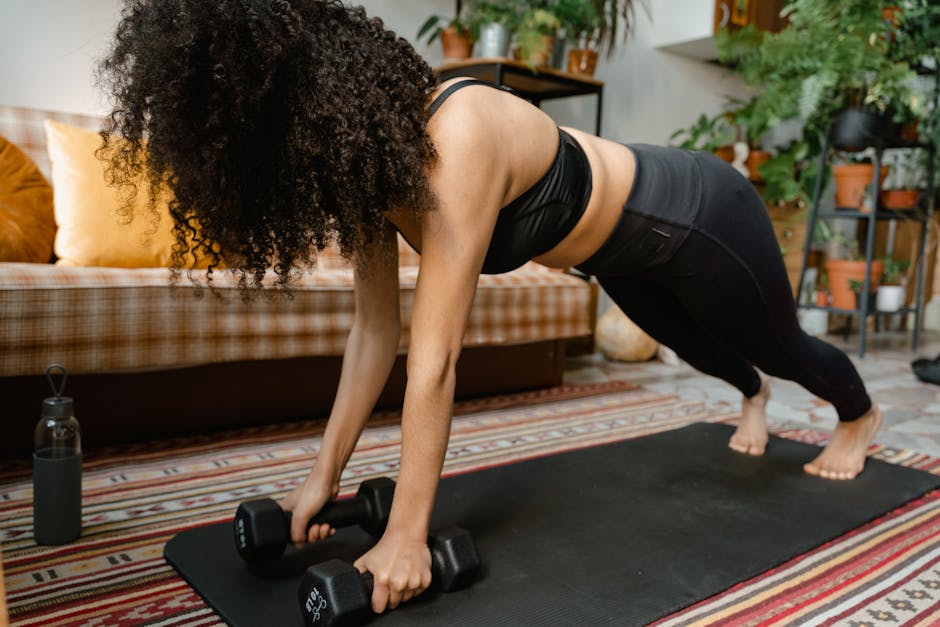
This is strength training for beginners with no equipment. You need a chair, a clear section of wall, and some floor space if floor work feels comfortable. Each movement below has a substitute, so every major muscle group the CDC names gets attention during the week.
- Chair squat: Stand up from a chair. Sit back down slowly. Substitute: Use a higher chair, or hold the chair back for support.
- Wall push-up: Place your hands on a wall at chest height. Bend your elbows, then press away. Substitute: Stand closer to the wall for a smaller range of motion.
- Glute bridge: Lie on your back with your knees bent. Lift your hips, then lower them. Substitute: Hold a chair and extend one leg behind you (a standing hip extension).
- Prone back lift: Lie face down. Gently lift your upper body only as far as feels comfortable. Substitute: Stand tall and gently draw your shoulder blades together.
- Bird dog: Start on your hands and knees. Reach one arm or the opposite leg away from your body. Substitute: Stand beside a chair, hold it, and reach your free arm forward.
- Standing arm press: Press your palms together in front of your chest and hold. Substitute: Press your palms into a wall at chest height.
Pick one version of each movement before you start. Move slowly. Use a stable surface. Stop any movement that causes pain. The substitute isn’t a lesser option. It’s simply the version you can repeat with more confidence today.
Who should check with a clinician first
Talk with a clinician before you start or change this routine if you have an injury, a health condition that affects how you move, recent surgery, chest symptoms, dizziness, or any doubt about which activities are right for you. Ask which movements suit you, and whether the chair, wall, floor, or standing versions fit your situation.
4-Week Plan
Treat this as a weekly rhythm, not a test you pass or fail. The CDC recommends at least 2 days of muscle-strengthening activity each week, working all major muscle groups. Put your two days on the calendar now. On each day, go through the list at a pace that lets you pay attention to your position and comfort. Here’s how the four weeks build:
| Week | Focus | Home routine | Simple progression |
|---|---|---|---|
| Week 1 | Learn the movement choices. | Do the chair squat, wall push-up, glute bridge or hip extension, back lift or shoulder-blade squeeze, bird dog or standing reach, and arm press. | Pick the easiest stable version of each movement. |
| Week 2 | Repeat the same routine. | Do the same list on 2 days. Notice which setup feels most comfortable. | Keep the versions that felt steady in Week 1. |
| Week 3 | Make one small change if you want to. | Repeat the routine. Change only one movement, and only if your earlier version now feels familiar. | For example, move from a wall push-up to a kitchen-counter push-up, or use a lower chair if that feels right. |
| Week 4 | Build a routine you can repeat. | Use the versions you want to keep for next month, still covering the major muscle groups on 2 days. | Keep it simple enough to do again next week. |
How to start resistance training for beginners without overthinking it

Set up the room. Put the chair somewhere it won’t slide. Clear a section of wall. If you don’t want to do floor work, choose the standing substitutes before you start so you don’t have to improvise halfway through.
Make the days obvious. Write “strength” on two days of your weekly calendar, then do the same short list both times. Variety isn’t the point yet. When the movements are familiar, it’s easier to tell whether a chair height, a wall position, or a standing version suits you.
Don’t treat effort as all or nothing. Researchers have compared resistance-training variables such as load, sets, frequency, and whether to train to muscular failure. That’s useful background, but you don’t need to turn your first month into an experiment. Choose your movements, repeat them, and change one thing only when you have a reason.
What the research supports, and what it doesn’t show
| What the research supports | What it does not show |
|---|---|
| CDC guidance calls for muscle-strengthening activity on 2 or more days a week and names the major muscle groups to work. | The CDC guidance doesn’t set one required home exercise list, chair height, or floor movement. |
| A systematic review and network meta-analysis of randomized trials in healthy adults looked at how combinations of load, sets, and frequency affect strength and muscle size. | It doesn’t offer a women-only or home-only beginner routine. |
| A systematic review and meta-analysis compared training to repetition failure with stopping short of failure, including subgroups of trained and untrained people. | Nothing in its description makes training to failure a requirement for this home plan. |
| A systematic review and meta-analysis compared low-load and high-load protocols, with all sets taken to momentary muscular failure. | That comparison doesn’t mean a beginner has to use weights or heavy loads at home. |
The takeaway is modest. Regular muscle-strengthening work is part of the recommended activity for adults, and research looks at more than one way to set up resistance training. This plan stays simple on purpose. Its job is to help you build a regular habit before you fine-tune anything.
Research and guideline links
The weekly structure comes from the CDC adult physical activity guidance. The Physical Activity Guidelines for Americans is the broader federal resource on making physical activity part of your regular routine.
- Currier BS, et al. Resistance training prescription for muscle strength and hypertrophy in healthy adults: a systematic review and Bayesian network meta-analysis. British Journal of Sports Medicine, 2023. PMID: 37414459.
- Grgic J, et al. Effects of resistance training performed to repetition failure or non-failure on muscular strength and hypertrophy: a systematic review and meta-analysis. Journal of Sport and Health Science, 2022. PMID: 33497853.
- Schoenfeld BJ, et al. Strength and Hypertrophy Adaptations Between Low- vs. High-Load Resistance Training: A Systematic Review and Meta-analysis. Journal of Strength and Conditioning Research, 2017. PMID: 28834797.
FAQ
What is resistance training for beginners?
It’s muscle-strengthening activity organized into a few manageable movements and a schedule you can repeat. In this plan, that means body-weight movements with home-friendly substitutes, done on 2 days a week.
What is weight training for beginners if I have no weights?
People often use “weight training” as a broad label for resistance work. Strength training for beginners with no equipment can start with chair squats, wall push-ups, standing options, and slow, controlled body-weight movements. The CDC guidance focuses on muscle-strengthening activity and major muscle groups, not on any particular equipment.
How do I start weight training for beginners after these four weeks?
Keep the two-day rhythm and keep working the major muscle groups the CDC lists. Repeat the versions that felt stable, or change one movement at a time. A realistic routine you keep doing is worth more than a complicated one you quit.
Related on Longview Desk
Not medical advice: This routine is general exercise information, not a personalized program. Start gradually, stop if you feel chest pain, dizziness, or unusual shortness of breath, and check with your doctor or another qualified clinician first if you have a health condition or an injury, or are pregnant.
This article was written by the site’s author with the assistance of AI tools, and reviewed before publication.